
Conservatory Roof Insulation
If you want quality products and a service you can trust, contact West Midlands Double Glazing today to get your customised quotation. Call us on 0121 468 1653 for a friendly chat or use our form to request a call back.
Get in Touch Today
Payment Options & Flexibility
From concept to completion, we handle every stage of your renovation in-house — design, build, installation and aftercare — meaning no third-party contractors and a seamless experience from start to finish.

Flexible Payment Plans
Spread the cost of your renovation through staged payments that align with your project milestones.

0% & Low-Rate Finance Options
Choose from a range of finance plans, including interest-free options on qualifying projects.

Deposit Protection & Secure Payments
Your deposit is fully protected, and all payments are handled safely through trusted, regulated partners.
Find the best Conservatory Roof Insulation for your home
The WMDG ThermOsave Conservatory Roof Insulation System is a proven method to keep your conservatory warm in the winter and cool in the summer.
Without high quality conservatory roof insulation, the conservatory can often become the most unusable room in a home for large portions of the year. The age old complaint of old polycarbonate conservatories being sweltering hot in the warmer months and icily chilly in the winter months is a common one we hear from our customers.
Many of our customers opt to completely replace their old conservatory roofs with a new solid conservatory roof. However, when a conversion of this nature is outside of your budget, this is where our ThermOsave system comes into play…
Customer Reviews






Process
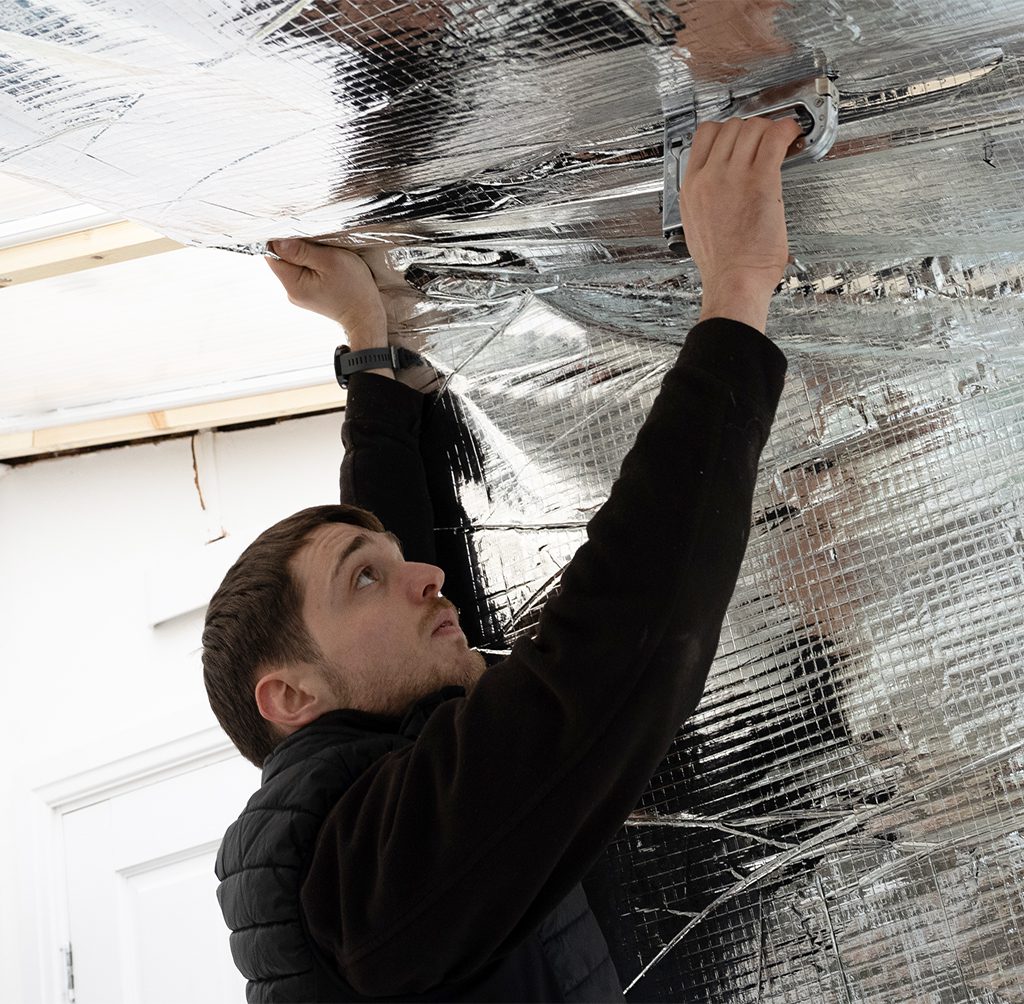
Step 1 – Specially treated timber battens are precisely fixed to each of the frames of your conservatory roof.
Step 2 – Our unique 5.5mm insulation sections are attached to the timber battens.
Step 3 – The 5.5mm insulation sections are precisely fixed to cover and fully insulate your entire conservatory roof.
Step 4 – A second stage of treated timber battens sandwich the roof insulation and create the second air gap.
Step 5 – The treated timber battens follow the contour of your roof to where it joins your home ensuring a tight finish.
Step 6 – The white uPVC panels are fixed to the second set of battens. This provides the maximum air gap needed.
Step 7 – The white uPVC panels are precisely cut on site to follow the existing roof profile.
Step 8 – Work completed – your conservatory will be cooler in the summer and warmer in the winter.
ThermOsave installations are incredibly efficient and can usually be completed in just one day!
The installation also comes with WMDG’s 10 Year Guarantee as standard.
Make an enquiry with us now to transform your conservatory from the most unused room to the most comfortable room in your home.
Thermally Efficient
Stop losing heat through your conservatory roof! With energy prices showing no sign of returning to normal levels any time soon (not to mention inflation!), you want to keep as much heat inside your home when you do put the heating on. Old polycarbonate conservatory roofs are one of the biggest culprits when it comes to a home’s heat loss and should be a first port of call when looking for priority areas to insulate.
Foil insulation is a very simple idea. Use pure aluminium to reflect heat back to the heat source. So, why do so many companies get it wrong?
It is possible to reflect heat with a single layer of aluminium. The problem is, when you do that,
it creates an increased risk of condensation forming on the surface of the product. The obvious answer is to add an additional separating layer to reduce the risk of condensation and to create a thermal break.
Different companies have tried to do this in several ways using various materials and methods. However, the problem is the materials and methods of production tend to create additional problems which then need to be addressed.
Multi foil insulation
Multi foil insulation is a multi layered product comprising of many, many layers. This tends to make them thick, dense and heavy which defeats the purpose of a thin lightweight reflective insulator. It also makes them hard to handle during installation.
A lot of ‘foil’ insulation products are made from a material called mylar instead of aluminium. Only aluminium has a naturally low emissivity value. Mylar is much cheaper to produce. It is a plastic laminated or painted with aluminium coating.
Companies that use mylar claim it to be a low emissivity product. But mylar, while it looks shiny and is good at reflecting light, does not reflect heat in the same way as aluminium.
You tend to see mylar used in a lot of single use application. Emergency foil blankets, packets of crisps and chocolate wrappers. It might be good at keeping food fresh but it’s not something you want used in an insulation material.
These coated plastics crack, peel and de-laminate within a very short space of time (especially when it is exposed to heat and cold as often as insulation is), and you end up with the emissivity value of plastic rather than aluminium.
Bubble wraps and single layered products have an increased risk of the condensation forming on or in the product
Glued and laminate products contribute to fire spread, the glues break down over time and the products de-laminate, especially when subjected to heat and coldness; the way insulation is.
The obvious problem with a fibrous material is that it can absorb moisture. However, products with fibrous cores usually have multiple layers. They are typically referred to as multi-foil insulations and these can have a whole host of problems.
Low-E insulation is not designed to replace all other insulation materials on the market. It is
specifically designed to provide moisture protection, to stop draughts, to deaden sound and to provide maximum thermal efficiency.
For years, people have thought to insulate better they should simply add more and more material believing that the thicker the insulation, the more efficient it would become.
However, through the combination of the high quality Low-E insulation and the adjacent air gaps, up to 97% of radiant heat can be reflected.
The easiest way of explaining how air gaps work is to use a double glazed windows as a comparative example. Two panes of glass on their own do nothing. Yet, when they are layered and separated by an small amount of space (air gap), that is what makes them more energy efficient and the principle is the same with our ThermOsave installations.